Monday, February 15, 2021

Class-5 Hindi Lesson-22 में पुस्तक हूँ


EVENTS CONVENT HIGH SCHOOL

15/02/2021        CLASS-5          SLOT-2
Hindi
Lesson-22
में पुस्तक हूँ
_______________________________________


श्रुतिलेख  

1.  भंडार

2.  विद्वान

3.  लेखक

4.  संपूर्ण

5.  विश्वकोश

6.  अमीर

7.  परिश्रम

8.  छापाखाना

9.  वैज्ञानिक

10. मजेदार

11. पुस्तकालय

12. बटोरना

13. हस्तलिखित

14. परिश्रम

15. ज्ञानी


1.  अति लघु उत्तरीय प्रश्न

प्रश्न .1एक मनुष्य को मनुष्य किसने बनाया ?

उत्तर .1मनुष्य को मनुष्य पुस्तक ने बनाया।

प्रश्न.2 संसार के संपूर्ण ज्ञान का भंडार कहां विद्यमान है?

उत्तर.2 संसार के संपूर्ण ज्ञान का भंडार पुस्तकों में विद्यमान है।।

प्रश्न .3 पुस्तक किन लोगों में अंतर नहीं करती?

उत्तर .3पुस्तक अमीर और गरीब लोगों में अंतर नहीं करती।


2.  लघु उत्तरीय प्रश्न

प्रश्न .1मनुष्य और पशुओं में क्या अंतर है?

उत्तर .1मनुष्य पड़ सकता है पशु पढ़ नहीं सकते।

प्रश्न.2 पुस्तक में कौन-कौन से विषय आते हैं ?

उत्तर.2 पुस्तक में हिंदी अंग्रेजी गणित विज्ञान विषय आते हैं।

प्रश्न .3 पुस्तक कहां कहां निवास करती है?

उत्तर .3 पुस्तक विद्यालय और पुस्तकालय में निवास करती है।

प्रश्न .4 पुस्तक का उद्देश्य क्या है?

उत्तर .4 पुस्तक का उद्देश्य हे कि मनुष्य पुस्तक को पढ़कर महान बन सके।


Class-8 Computer Chapter-7 Introduction to Adobe Photoshop CS6


EVENTS CONVENT HIGH SCHOOL

15/02/2021        Class-8          SLOT-2
Computer
Chapter-7
Introduction to Adobe Photoshop CS6
_______________________________________


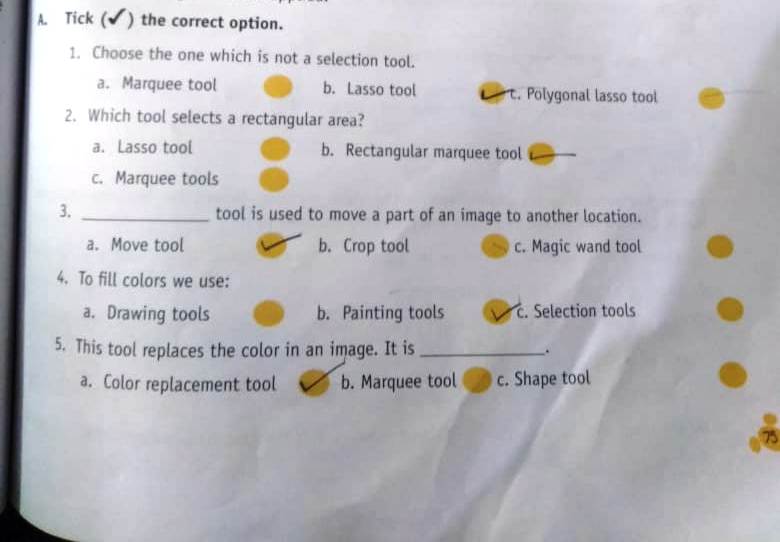
D.Answer the following questions:-

 Que-1What is the use of colour replacement tool?

Ans-1 Colour replacement tool allows you to replace the colour of an image with the foreground colour.


 Que-2What are shape and custom shape tool?

Ans-2 Shape tool: To draw shapes like rectangle round rectangle ellipse polygon and line we use shape tool

 Custom shape tool: There are a variety of preset shapes in Photoshop like a flower or a great to use them the use custom shape tool.


 Que-3Write steps to start Adobe Photoshop

Ans-3 Step-1to start Adobe Photoshop follow this steps.step 1 starting Photoshop is very easy just drag the mouse pointer to the extreme left corner on your desktop.

Step-2  Click on start button.

Step-3 Now click on all programs click > Adobe Photoshop cs6

Step-4 Photoshop will open.

 Que-4 Describe the selection tools?

Ans-4 Selection tool are used to select a part of an image or a subject of its. Selection tools help us in editing and applying effects on the selected parts of the image selected parts get highlighted using a dashed border while the unselected area is left untouched. Let's learn more about these tools, what they do and how to use them.

Class-8 Social Science Chapter-14 Revolutionary Movement in India


EVENTS CONVENT HIGH SCHOOL

15/02/2021        CLASS-8          SLOT-2
Social Science
Chapter-18
Revolutionary Movement in India
_______________________________________

Question 1.Who was not among the revolutionary activity in foreign country?

(a) Shamji Verma

(b) Sardar Ajeet Singh

(c) Madan Lal Dhingra

(d) Vinayak Damodar Savarkar

Answer:

(b) Sardar Ajeet Singh


Question 2.Who hoisted Indian Flag in 1907 in Germany?

(a) Bhikaji Camma

(b) Lala Hardayal

(c) Mrs Annie Besant

(d) Lala Lajpat Rai

Answer:

(a)Bhikaji Camma


  Question 3.In which district of Madhya Pradesh Chandra Shekhar Azad was born?

(a) Jhabua

(b) Mandla

(c) Raisen

(d) Panna

Answer:

(a) Jhabua


Question 4.Azad Hind Fauz was founded by

(a) Subhash Chandra Bose

(b) Capt. Mohan Singh

(c) Capt. Prem Kumar Sehgal

(d) Shahnawaz Khan

Answer:

(b)Capt. Mohan Singh


Fill in the blanks :

 1.Shyamji Verma founded in Indian house in London 1905 in London.

2.In 1908 Khudi Ram Bose threw bomb on The carriage of the defamed judge Kingsford

3.Dev Narain Tiwari was hanged to death in 1931


Question 1.Write the names of prominent revolutionaries of Madhya Pradesh?

Answer:Chandra Shekhar Azad, Thakur Yashwant Singh, Dev Narain Tiwari, Dalpat Rao were the prominent revolutionaries of Madhya Pradesh.

 
 Question 2.Which villages were occupied by Basudev Balwant Phadke?

Answer:Basudev Phadke was the leader of the revolutionary movement with the help of few people he occupied Dhamri, Balte Palspe villages in 1879.


Question 3.Who was assassinated by Chapekar Brothers?

Answer:In 1897 Damodar and Balkrishan Chapekar brothers murdered Rand, head of the Plague Committee and Lieutenant Amherst in Pune.


Short Answer Type Questions

 Question 1.Describe about the revolutionary activities in abroad?

Answer:Indian revolutionaries were active in other parts of the world also Shyamji Verma established ‘India House’ in London in 1905. He started sociolongistic magazine and scholarships.Vinayak Damodar Savarkar, Birendranath Chattopadhyay, Tirumal Acharya, Bhikaji Camma, Bhai Permanand, Madan Lal Dhingra and Lala Hardayal were the active members of this society.

  Madan Lal Dhingra in 1909 killed Curzon Vailer the Secretary of India. He was hanged and Sarvarkar was sent to cellular jail at Andaman Island. In US the Ghadar party was formed in 1913. Lala Hardayal was the key activist of this party. The Ghadar magazine was published.

Question 2.What was Kakori Conspiracy? Describe it?

Answer:Money was required to run the revolutionaries movements. A group of revolutionaries were successful in robbing the govt, cash at the Kakori Railway station on August 2. 1925 on Saharanpur-Lucknow line. Many of them were arrested after this incident and they were tried in the Kakori Conspiracy Case.

 Question 3.Write the names of key organisation of the second phase revolutionary movement?

Answer:The following were the main revolutionary organisations of the second phase:

 Youth sabha founded by the Bhagat Singh, Yeshpal and Chhabildas.

Hindustan Democratic Republic

Hindustan Socialist Republic Association. In 1928 Chandra Shekhar Azad, Sachidra Nath Sanyal, Ram

Prasad Bismil together changed the name of Hindustan. Republic Association as Hindustan Socialist

Republic Association.

Azad Hind Fauz. It was founded by Captain Mohan Singh.


 Write notes on:

 1.Azad Hind Fuaz:

At the initiative of Rashbehari Bose, Captain Mohan Singh (one of the Indian soldiers taken prisoner by Japanese) formed the Azad Hind Fuaz. Subhash Chandra Bose instilled new energy into Azad Hind Fuaz and became famous by the name of Netaji.

 In the capacity of leader of Azad Hind Fuaz he formed temporary India Govt, in Singapore on October 23 and took vow to shed last drop of blood for the freedom of the country. In 1944 Azad Hind Fauz was successful in moving up to the eastern border of India.

 In 1944 he hoisted Indian flag in Kohima. And then seized Imphal but due to paucity of ration and excess rains he had to retreat from there. Netaji gave the slogan “Give me blood and I will give you freedom”.

 In 1944 the position of Japan in world politics had become very weak. So the Azad Hind Fauz began to disintegrate.


2. Chandra Shekher Azad:

Chandra Shekhar Azad was born at Bhavra village in Jhabua district in Madhya Pradesh. He embraced non-cooperation movement at the tender age of 14. When he was arrested he told his name was Azad.

 His role in Kakori conspiracy, Saunder’s killing and bombing at the assembly was notable. Finally surrounded by British police at the Alfred park in Allahabad, he shot himself dead. He paid his life for the freedom of India. He will be remembered for his great sacrifice for his motherland.


Class-9 English Chapter-10 Kathmandu

EVENTS CONVENT HIGH SCHOOL

15/02/2021        CLASS-9          SLOT-2
English
Chapter-10
Kathmandu
_______________________________________


I. Answer these questions in one or two words or in short phrases.

Question 1.Name the two temples the author visited in Kathmandu.

Answer:Pashupatinath and Baudhnath Stupa.

 Question 2.The writer says, “All this I wash down with Coca Cola.” What does ‘all this’ refer to?

Answer:Com-on-the-cob and marzipan.

 Question 3.What does Vikram Seth compare to the quills of a porcupine?

Answer:The flutes tied on the top of the flute seller’s pole.


Question 4.Name five kinds of flutes.

Answer:The reed neh, the recorder, the Japanese shakuhachi, the deep bansuri, the breathy flutes of South America, the high pitched Chinese flutes.

II. Answer each question in a short paragraph.

Question 1.What difference does the author note between the flute seller and the other hawkers?

Answer:The author finds a difference in selling the articles. The flute seller does not shout out his wares. He makes a sale in a curiously offhanded way as if this was incidental to his enterprise.

Question 2.What is the belief at Pashupatinath about the end of Kaliyug?

Answer:People believe that when a small shrine emerges fully on Bagwati river, the goddess inside will escape, and the evil period of the Kalyug will end on earth.


III. Answer the following questions in not more than 100-150 words each.

Question 1.Compare and contrast the atmosphere in and around the Baudhnath shrine with the Pashupatinath temple.

Answer:At Pashupatinath there is an atmosphere of ‘febrile confusion’. Priests, hawkers, devotees, tourists, cows, monkeys, pigeons and dogs roam through the grounds. There are so many worshippers that some people trying to get the priest’s attention are elbowed aside by others pushing their way to the front. At the Baudhnath stupa, the Buddhist shrine of Kathmandu, there is a sense of stillness. Its immense white dome is ringed by a road. Small shops stand on its outer edge. Most of the shops are owned by Tibetan immigrants. There are no crowds and this is a haven of quietness in the busy streets around.

Question 2.How does the author describe Kathmandu’s busiest streets?

Answer:The author says that Kathmandu is vivid, mercenary, religious, with small shrines to flower-adorned deities along the narrowest and busiest streets. There are fruit sellers, flute sellers, hawkers of postcards, shops selling western cosmetics, film rolls and chocolate or copper utensils and Nepalese antiques. Film songs blare out from the radios, car horns sound, bicycle bells ring, stray cows low, vendors shout out their wares. The author buys a com-on- the-cob roasted in a charcoal brazier on the pavement. He also buys coca cola and orange drink.

 Question 3.“To hear any flute is to be drawn into the commonality of all mankind.” Why does the author say this?

Answer:The author says this because he is aware of the fact that music appeals to senses. It gives pleasure to every listener. The flute seller does not sell only one kind of flute. He has various types of flutes that represent different customs and culture. The flute seller is a wise sales person. He does not shout out his wares. He plays melodious tunes which fascinate others. Mankind does not have multiple appearances and shapes. It is universal and cosmopolitan. Music soothes everyone’s heart irrespective of their caste, colour and creed. So the author says that to hear any flute is to be drawn into the commonality of all mankind.


Thinking about language

Question 1.Match the phrasal verbs in column A with their meanings in column B.

A                                             B

(i) break out                             (d) to start suddenly, (usually a fight, a war or a disease)

(ii) break off                            (a) to come apart due to force

(iii) break down                       (f) stop working

(iv) break away (from someone)         (b) end a relationship

(v) break up                             (e) to escape from someone’s grip

(vi) break into                          (c) break and enter illegally; unlawful trespassing


Question 2.Use the suffixes -ion or -tion to form nouns from the following verbs. Make the necessary changes in the spellings of the words.

Example: proclaim-proclamation


Question 3.Now fill in the blanks with suitable words from the ones that you have formed.

1.      Mass literacy was possible only after the of the invention printing machine.

2.      Ramesh is unable to tackle the situation as he lacks imagination

3.      I could not resist the temptation to open the letter.

4.      Hardwork and dedication are the main keys to success.

5.      The children were almost fainting with exhaustion  after being made to stand in the sun. 

Saturday, February 13, 2021

Class-5 English Chapter-11 Kalpana Chawla


EVENTS CONVENT HIGH SCHOOL

13/02/2021        CLASS-5          SLOT-2
English
Chapter-11
Kalpana Chawla
_______________________________________
 

New words

1.      Voyage

2.      Astronaut

3.      Confined

4.      Flying club

5.      Attitude

6.      Mantra

7.      Respectively

8.      Spacecraft

9.      Fascinated

10.  Commercial

11.  Determined

12.  Pursuit

13.  Reluctantly

14.  Mere

15.  Doctorate


A.    Answer the questions:-
Que-1 Where was kalpana chawla born?
Ans-1 Kalpana was born on 1july,1961 in karnal, a small town of Haryana in India.

Que-2 How did kalpana get fascinated by the stars?
Ans-2 At summer nights the family slept in the courtyard under the stars.She would be fascinated by them.

Que-3 Why did kalpna study aerospace engineering?
Ans-3 Kalpana was so excited about flying,she chose the branch  of aeronautical  engineering for study.


Que-4 Why did kalpana go to become a rocket scientist and astronaut?
Ans-4  She took admission in the master’s course in aerospace engineering in Texas in United States (of America).

Que-5 What Experiment did the scientist perform on Columbia STS-107 Mission?
Ans-5 The research scientist studied the Insects, fishes, crystals, waves, fire along with themselves in space for 16days.

Class-9 Science Chapter-9 Force and Law


EVENTS CONVENT HIGH SCHOOL

13/02/2021        CLASS-9          SLOT-2
Science
Chapter-9
Force and Laws of Motion

_______________________________________


Question 1. Which of the following has more inertia:

(a) a rubber ball and a stone of the same size?

(b) a bicycle and a train?

(c) a five-rupees coin and a one-rupee coin?

Answer:(a) A stone of the same size

(b) a train

(c) a five-rupees coin

As the mass of an object is a measure of its inertia, objects with more mass have more inertia.


Question 2. In the following example, try to identify the number of times the velocity of the ball changes.

“A football player kicks a football to another player of his team who kicks the football towards the goal The goalkeeper of the opposite team collects the football and kicks it towards a player of his own team”.

Also identify the agent supplying the force in each case.


Answer:

 The velocity of football changed four times.

Question 3. Explain why some of the leaves may get detached from a tree if we vigorously shake its branch.

Answer: When the tree’s branch is shaken vigorously the branch attain motion but the leaves stay at rest. Due to the inertia of rest, the leaves tend to remain in its position and hence detaches from the tree to fall down.

Question 4. If action is always equal to the reaction, explain how a horse can pud a cart?

Answer:4 The third law of motion states that action is always equal to the reaction but they act on two different bodies.In this case the horse exerts a force on the ground with its feet while walking, the ground exerts an equal and opposite force on the feet of the horse, which enables the horse to move forward and the cart is pulled by the horse.

Question 5. Explain, why is it difficult for a fireman to hold a hose, which ejects a large amount of water at a high velocity.

Answer:5 The water that is ejected out from the hose in the forward direction comes out with a large momentum and equal amount of momentum is developed in the hose in the opposite direction and hence the hose is pushed backward. It becomes difficult for a fireman to hold a hose which experiences this large momentum.

Question 6. From a rifle of mass 4 kg, a bullet of mass 50 g is fired with an initial velocity of 35 m/s. Calculate the initial recoil velocity of the rifle.