Friday, January 8, 2021

Class-2 Hindi पाठ-15 रानी लक्ष्मी बाई

 EVENTS CONVENT HIGH SCHOOL

Class-2
पाठ-15
 रानी लक्ष्मी बाई

1. कठिन शब्द

. लक्ष्मीबाई

. मोरोपंत

. साहसी

. घुड़सवार

.साहेब

. झाँसी

. गंगाधराव

. निधन

. अंग्रेज़

१०.राज्य

११.सर्कार

१२. महिलाओ

१३.वीरतापूर्वक

१४. बांधकर

१५. शहीद


2 . सवालों के जवाब लिखिए

प्रश्न- लक्ष्मीबाई के बचपन का क्या नाम था?

उत्तर- मनु |

प्रश्न- रानी लक्ष्मीबाई ने दूत से क्या कहा ?

उत्तर- में अपनी झाँसी नहीं दूँगी|


Thursday, January 7, 2021

Class-4 Computer Chapter-5 Ms Power Point 2013

 EVENTS CONVENT HIGH SCHOOL

COMPUTER
Chapter-5 
MS.POWER POINT 2013


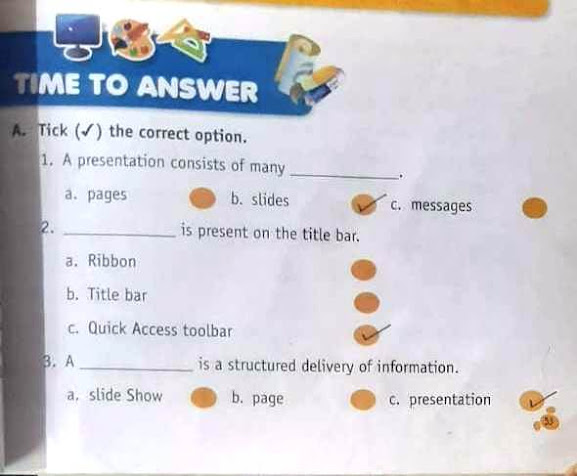
D. Answer the following questions:-

Que-1 Write the components of Power point?

Ans-1 The components of power point are as follow:

      1.Title bar                 2.Quick access toolbar            3. Ribbon              4.Office button           5.Slide pane               6.Slides tab                             7.Outline tab         8. Notes Pane.

Que-2 What is a Presentation?

Ans-2 A presentation is a structured delivery of information. It is a systematic display of information along with graphics, movies and sounds.

 Que-3 What is MS power point?

Ans-3 Microsoft Powerpoint is a presentation graphics softwares developed by Microsoft.

 Que-4 Write steps to create new presentation?

Ans-4 1. Click on the file tab > New option.

2.Choose the Blank presentation option. Click on Create button. Then double click on presentation.

3. A new presentation with a blank slide will open in the power point screen.

4. The default slide that appears when you create a new presentation is title slide layout, which displays the dotted rectangular  boxes called placeholders.

5. To add a new slide, click on new slide.


Class-8 Social Science(History) Chapter-3 Struggle against British Rule

 EVENTS CONVENT HIGH SCHOOL

Social Science  

Chapter 3
Struggle Against the British Rule


A.Chosse the correct option of the following

Question 1.Which uas nottriba1 uprising
(a) Vellore uprising 
(h) Bull uprising
(c)  Santhal upring
(d) Mundda uprising

Answer:(a) Vellore uprising


Question 2.Who did not join 1857 struggle
(a) Rani Laxmi BaI
(b) Tatya Tope
(c) Bahadur Sháh Zafar
(d) Dileep Singh

Answer:
(d) Dileep Singh


Question 3.Which of the British policy Thred Bhil? to revolt?
(a) industrial policy
(b) Agriculture policy
(c) religious policy
(d) State’s inter ference

Answer:
(b) Agriculture policy


B. Very Short Answer Type Questions

Question 1.Which book mentions about San yasi struggle?
Answer:Bankim Chandra Çhatarjee mentioned about Sanyasi uprising in his book. “Anand Math”


Question 2Who Iedthe SanUil uprising”
Answer:The Sauthal uprising was led by leaders Sido and Kanhu.


Question 3.Who was the leader of Wahabi upring?
Answer:Sayyed Ahmed of Raibareily led the Wahabi streiggie.

 C. Short Answer Type Questions

Question 1.When and where Khol uprising took place?
Answer:The kohl led Budho Bhagat Bharat lanched revolit in 1831 in singhbham ranchi palamu hajari bagh manbhumi and other pleces the kohls protested against their landas given to muslim and sikh peasants.


Questions 2.Name the places of India where 1857 struggle was ‘widespread?
Answer:The places where the 1857 struggle was wide spread were Delhi. Awadh. Rohilkhand. Bundelkhand Allbhahad, Agra Meerut. Kanpur and jhansi.

 D. Long Answer Type Questions

Question 1.Describe the Santh:il uprising?’
Answer:The Snthal revolt was led by Santhal leaders and sido and Kanhu in 1856. It was one of the most power ful uprisings. ‘The opposed the maltreatment up-rings they opposed the maltrrement of lands revenu offioal in daman -e- koh area this area lies between Bhagalpur and Rajmahahal the santhals declared end of the company rule in their region and revolt and were later suppressed by Britisher’s.


Question 2.What were the major cuses of the failure of 1857 struggle
Answer:There were many causes that led to the failure of the revolt of 1857:

·         Not Planned –  The revolt of 1857 was not well planned. it sparked off abruptly

·         Localized – It was Wotan all-India revolt It was localized in certain areas. it dd not start in South and Punjab

·         New Emerging middle class did not participated

·         some Indian rulers are sided with the British: some Indian rulers kept away while some rulers sided with the English

·         lack of resource – the rebel did not have enough financial resources and weapons of war.


Question 3.Write notes on:
1. sanyasis upring
2. Whabi upring


Answer:1: sanyasis upring:this upring was important among other civil up-rings. the apathy of British government after 1770 famine in Bengal economic loot and ban on religious they attacked fractious colonies and forts of the company governor General Warren Hastings could brought the revolt under control.


2. Whabi upspring :sayyed Ahmed of Railbareilly led the Wahhabi And changes in Islam sayyed Ahwed launned revolt against sikh rule in Punjab and when company took control over Punjab in 1849 Wahhabi raised rebellion against British rule got most powerful challenge from Wahhabi struggle.


Question 4 .make an album with the help of leaders who participated in 1857 struggle.


Class-9 Social Sciene Chapter-4 Electrol Politics


EVENTS CONVENT HIGH SCHOOL

Social Science Civics
Chapter 4 Electoral Politics


1. Which of the following statements about the reasons for conducting elections are false?

(a) Elections enable people to judge the performance of the government.
(b) People select the representative of their choice in an election.
(c) Elections enable people to evaluate the performance of the judiciary.
(d) People can indicate which policies they prefer.

Answer: 
(c) Elections enable people to evaluate the performance of the judiciary.

2. Which of these is not a good reason to say that Indian elections are democratic?
(a) India has the largest number of voters in the world.
(b) India’s Election Commission is very powerful.
(c) In India, everyone above the age of 18 has a right to vote.
(d) In India, the losing parties accept the electoral verdict.

Answer: 
(a) India has the largest number of voters in the world.

3. Match the following:

(a) It is necessary to keep the voters’ list up to date because

(iv) some people may have moved away from the area where they voted last

(b) Some constituencies are reserved for SCs and STs so that

(i) there is a fair representation of all sections of our society

(c) Everyone has one and only one vote so that

(ii) everyone has equal opportunity to elect their representatives

(d) Party in power is not allowed to use government vehicles because

(iii) all candidates must have a fair chance of competing in elections


4. List all the different election-related activities mentioned in the chapter and arrange them in a time sequence, beginning with the first activity and ending with the last. Some of these activities are given below: releasing election manifestos; counting of votes; making of voters’ list; election campaign; declaration of election results; casting of votes; ordering of re-poll; announcing election schedule; filing nomination.


Answer:
Making of voters’ list → Announcing election schedule → Releasing election manifesto → Election campaign → Filing nomination → Casting of votes → Ordering of re-poll → Counting of votes → Declaration of election results.

5. Surekha is an officer-in-charge of ensuring free and fair elections in an assembly constituency in a state. Describe what should she focus on for each of the following stages of election:
(a) Election campaign
(b) Polling day
(c) Counting day

Answer:
(a) She will have to focus on various duties such as ensure that candidates cannot bribe or threaten voters, expenditure limit is not crossed by a candidate, candidates not appeal to voters in the name of religion or caste, they not use worship place for a campaign or use any government resources.

b) She will have to crosscheck the voters’ list and check the ID proof of the voters, booth capturing not take place. Ensure that Free and fair elections should be conducted.

(c) She has to look on counting is carried out, representatives of all parties present at the counting area in order to avoid malpractices,

6. The table below gives the proportion of different communities among the candidates who won elections to the US Congress. Compare these to the proportion of these communities in the population of the US. Based on this, would you suggest a system of reservations in the US Congress? If yes, why and for which communities? If no, why not?
Answer:
Blacks and Hispanics should be given reservation in the US Congress as per their percentage in the US population.

7. Can we draw the following conclusions from the information given in this chapter? Give two facts to support your position for each of these.

Answer: (a) The Election Commission of India is powerful enough to conduct free and fair elections:

It implements the code of conduct and punishes any candidate or party that violates it.

In Elections, Government officials work under the EC and not the government.


(b) There is a high level of popular participation in the elections:

Voter turnout has increased over the past years.

Election-related activities in the last few years have seen larger participation by the people.


(c) It is not very easy for the party in power to win an election:

The ruling parties routinely lose elections.

Candidates who are known to spend a lot of money often lose elections.


(d) Certain Reforms are necessary to make our elections completely free and fair:

 To ensure that independents and small parties not suffer in elections.

To ensure candidates with criminal records not participate.


8. Chinappa was convicted of torturing his wife for dowry. Satbir was held guilty of practicing untouchability. The court did not allow either of them to contest elections. Does this decision go against the principles of democratic elections?

Answer:
This decision does not go against the principles of democratic elections. Any person who is convicted for a crime has not right to remain a part of the society and hence has no right to contest the election.


9. Here are some reports of electoral malpractices from different parts of the world. Is there anything that these countries can learn from India to improve their elections? What would you suggest in each case?


Answer:(a) In this case, representatives of each candidate should be present to make sure that the votes are counted in a fairway.

(b) The election commission should set up an inquiry into the case and debar the candidate or party involved in distributing such pamphlets.

(c) There should be a single election commission which should be free from political influence and should be responsible for conducting elections throughout the country.

Que 10. Here are some reports of malpractices in Indian elections. Identify what the problem in each case is. What should be done to correct the situation?

Answer:(a) After the announcement of the election, it is not legal to announce policy decisions according to the Code of Conduct. The minister should be immediately taken to task by the Election Commission.

(b) The election commission must ensure that all political parties are given equal opportunity to appear on Doordarshan and All India Radio. EC takes action against the misuse of this media.

(c) The presence of the fake voters means that the elections were rigged by the authorities who prepared the electoral rolls. The election commission should supervise the preparation of fresh electoral rolls.

(d) By using hoodlums, the political party is terrorizing its rivals. The election commission should order the arrest of the hoodlums and bar the party from the elections.

11. Ramesh was not in class when this chapter was being taught. He came the next day and repeated what he had heard from his father. Can you tell Ramesh what is wrong with these statements?

Answer:(a) The statement is wrong because the policy of secret ballot ensures that an individual can vote for whoever he/she wants. Women are fully capable of taking decisions on their own and selecting the candidate they like.

b) Competition works as both deterrent and motivator for the political candidates. Fear of losing the election and motivation for winning the elections works in favour of people.

(c) Educational qualification is not required to understand the people’s needs, and to represent their interests. Therefore, it is not necessary for politicians to be graduates.

Wednesday, January 6, 2021

Class-7 Computer Chapter-9 LOOPING STATEMENT

 EVENTS CONVENT HIGH SCHOOL

Computer
Chapter-8
LOOPING STATEMENT
 

A. Tick the correct option

1.Specifying is not compulsory in for next

a.Step(✓)              b.in                  c.next

 2.The variable used to specify a number of times a loop is executed

a.Next              b.for                c.control(✓)

 3.Gives back the control to while

a.Do (✓)          b.wend                         c.for

 4.Music can be played by using the instruction

a.Play               b.music            c.both a and b(✓)

 5.Increments the control variables and send the control back to for

a.Step               b.Next (✓)             c.Wend


B. Fill in the blanks

    1.      repeat command is used if we want to repeat a set of commands are fixed number of times in a program

 2.      Loop variable is used to specify how many times a loop is executed.

 3.      A s i i characters "\a" can create a beep sound when printed.

 4.      Control variable statement is used to increase or decrease the value of a control variable

 5.      In the for next loop control variable is assigned initial value and a  final value .


C tight T for true and F for false statements:-

1. We prefer not to use looping in our program because they increase our program [false]

 2. We can use only one control variable say c in three nested loops [false]

 3. WEND is used with a FOR clause [false]

 4.there cannot be more than 9 nested loops within one loop [True]

 5.the value of step should never be made negative to avoid in finite loops [True]


D.Answer the following questions:-

1. What do you understand by looping explain  

Ans-1In computer programming, a loop is a sequence of instruction s that is continually repeated until a certain condition is reached. Typically, a certain process is done, such as getting an item of data and changing it, and then some condition is checked such as whether a counter has reached a prescribed number.

2. What is a for next loop ?

Ans. The for... next statement is an iterative, incremental loop statement used to repeat a sequence of statements for a specific number of occurrences. ... This looping continues until the ending condition is met or the loop is explicitly exited with an exit or goto statement.

3. Why is step statement used in for next?

Ans-3 You can use For...Next statements to repeat a block of statements a specific number of times. For loops use a counter variable whose value is increased or decreased with each repetition of the loop.

4.What is a nested loop?

Ans-4  nested loop is a loop within a loop, an inner loop within the body of an outer one. How this works is that the first pass of the outer loop triggers the inner loop, which executes to completion. Then the second pass of the outer loop triggers the inner loop again. This repeats until the outer loop finishes.


Class-6 Computer Chapter-9 QB64 Statements

                          EVENTS CONVENT HIGH SCHOOL

Class-6
CHAPTER-9
QB64 STATEMENTS


A.Tick the correct option:

1. ____Statement can be used for controlling column location.

a.Tab(√)           b. print tab          c.LET

2. _____Statement terminates the further execution of program.

a.LET               bINPUT(√)         c. PRINT

3. IN QB64, when an item is enclosed in______ brackets, it indicates that is optional.

a.Square Brackets(√)    b. curly brackets           c.rounded brackets.

4.Print with, comma statement can display at the most_____ values in a line.

a.Four              b.five(√)             c.three.


B. Fill in the blanks:-

1.The input statement prints a question mark on the screen.

2. The TAB statement print tables type of results.

3. Input statement tells the computer to wait for the user to enter data.

4.The input program can have both numeric and alphanumeric variables

5. CLS command clear all the screen contents.


C. Write T for True and F for False statement:-

1. The input statement for the assignment statement assign a value to a variable- [False]

 2.the input programs can have numeric as well as alphanumeric variables –[True].

 3. An input statement can have a list of variables -[True].

 4. You can print only 5 values in a line-[True].


D. Answer the following questions:-

Que-1 What is the use of input statement?

Ans-1The INPUT statement used to take a data item from the user and then store it in a variable.

 Que-2 Write the use of print command using tab function?

Ans-2  It is used to move the position of the print to the column specified by its argument. It is mostly used for printing tables. Syntax:PRINT TAB(c): “Constant/Variable/Expression.

 Que-3 Give the use of assignment statement?

Ans-3 The LET statement of the assignment assigns a value to a variable. Its use is optional.

 Que-4 Write the difference between print statement with comma and semi column?

            Give an example of print with comma command?

Ans-4 Print with semi colon(;) displays the variable one after  another without leaving any space in between.

            Syntax: Print (Variable);  (Variable); (Variable); ……..

            LET A$ = “I”

            LET B$=  “LIVE”

            LET C$ = “IN”

            LET D$ = “INDIA”

            PRINT A$; B$; C$; D$


            Print with Comma (,) It displays the values one after the other with a lot of spaces in between (usually 14) It can print only five values in a line.

              Syntax: Print(Variable), (variable) ……

            LET A= 40

            LET B= 60

            C = A+ B

             Print A, B, “SUM”, C

              END